



This blog is called Unreal Blog for a reason: Reality, as we perceive it, is very unreal. What that weird statement means depends on the context. Here’s one context: If you look at the night sky, whatever you see, the stars, the galaxies etc., are all from the past. More importantly, the way we perceive motion, especially at high speeds, is completely unreal, which is the basis of special relativity. Here’s is a video explaining what I mean by that. Loving created by yours faithfully…
The physics details of this animation have been published in International Journal of Modern Physics D. Vol. 16, No. 06, pp. 983-1000 (2007) as “Are Radio Sources and Gamma Ray Bursts Luminal Booms?“
The transcript of the narration follows. You don’t need it because you will see it as the subtitles in the video. But in this age of Google, may be it is advisable to have it.
Here is a question we are not allowed to ask: If something were to travel faster than the speed of light, what would it look like to us? We are asking this question only a thought experiment.
An object, a star perhaps, is moving from left to right at ten times the speed of light, covering a distance of 20 light years in two years. The distance of closest approach to us is ten light years. What would it look like, to us?
The light from the object when on the left takes 14 years to get to us. But a year later, the object is directly above us. And the light from that point in space takes only 10 years to reach us. So the object would appear directly above us before it appears on the left. Or on the right. In other words, what we would see is completely different from what is happening out there. We would see an object appearing, out of nowhere, about 10 [not 11] years after it passes the point of closest approach. Then, it would appear to split and move in opposite directions.
But if any physicists hear of this thought experiment, they would say, “Nothing can travel faster than light. Therefore the question doesn’t make any sense. Even as a thought experiment, it doesn’t get off the ground.”
So let’s rephrase the question. Let’s say there is no physical object, moving in this thought experiment. It is a long, very long, strip of lights. Like, say 20 light years long. We have lights one light second apart. We have programmed them to turn on in a sequence, one every tenth of a second, giving us the illusion that the object is moving at ten times the speed of light. Nothing, no physical object, is moving. There is only one frame of reference. Are we okay now?
Even this scenario may face some objection. Some cautious physicists may say that it is not merely physical objects that are banned from breaking the light barrier. No information can be transmitted faster than the speed of light either. Therefore, the lights cannot be turned on in the sequence as described because the clocks implied in this scenario cannot be synchronized over such distances.
So let’s actually do all the synchronization and programming of the lights all in one point in space, and then move them into position. Yes, moving them, accelerating and decelerating, will destroy the synchronization. Let’s say that we know the velocity profile of each clock. We can pre-compute and pre-correct all the time dilation effects and get the whole experiment set up. Are we good now?
For the ease of description, we are going to that an object is flying by, rather than some lights are being turned on.
Having done all this thought work, let’s run this experiment once again, more carefully this time. As the object is flying by, it emits lights. The light coming toward us, from different points in the path of the object, takes different amounts of time to reach us. The instant in time when the light from a point reaches us is when we see the object at that point in space. The first instant any light from the object reaches us is when it is near the point of closest approach. Let’s call this point the core. So what we see is the object appearing at the core, then splitting into two, and then two objects (let’s call them the phantom objects) moving away from each other, rapidly at first and then slowing down. Our best interpretation would be that there was an explosion at the core and the phantoms are the fragments.
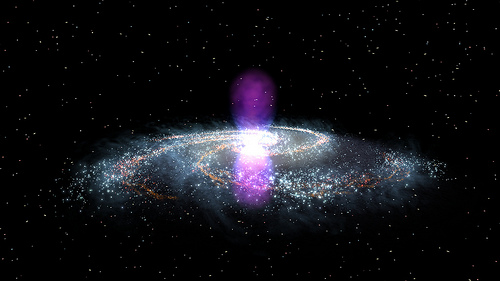
Now the question is, are there such, loosely symmetric objects in the cosmos? There are. They are the radio lobes associated with the so-called Active Galactic Nuclei or AGN. Their common features are a core region, thought to be a host galaxy, and a pair of much larger, roughly symmetric lobes that appear when viewed in the radio frequency ranges.
In our animation, we have drawn the phantom objects with colors turning from blue to red. It is not an accident or aesthetic license. The wavelength of the light reaching us is indeed modified because of timings and the superposition of the waves. Let’s look at it once more, this time with the advancing wavefronts included. This picture, in fact, is identical to the sonic boom in supersonic motion, with the so-called Mach cone. We can see that at the first instant in time when we see the object, it is the surface of expanding cone that passes over us. The frequency at that point is infinity. Right after that, the frequency quickly drops to gamma rays, x-rays, through the visible spectrum and onto microwaves and radio waves. What we are experiencing is indeed a “luminal boom.”
Now, are there beasts like this in our universe? Yes, they are the Gamma Ray Bursts, or GRB. Discovered in the sixties (accidentally, when looking for the gamma ray signatures of enemy nuclear tests), they appear at random points in space. The gamma ray emission lasts only for a short time, and then it quickly changes into X-ray and an optical afterglow. And they do show a correlation with AGNs.
What we have come up with is a model for Gamma Ray Bursts and the radio lobes associated with Active Galactic Nuclei. But with a fatal flaw: the model is based on superluminal motion, which is not allowed. Technically, it violates Lorentz Invariance. But remember, we did not have any real motion in our thought experiment or the animations. It was only a strip of lights being turned on in rapid succession. What creates the phantom objects is just the sequence in which the light from different points in the strip reaches us. And what creates the GRB-like effect and its evolution to AGNs is the squeezing and spreading of the time intervals between successive wavefronts.
There are indeed other models that explain such phenomena as Gamma Ray Bursts (GRB) and Active Galactic Nuclei (AGN), staying well within the bounds of special relativity.
Now we have a big question to answer. When we actually observe a phenomenon (GRB, for instance), are we supposed to peek behind what we see, and ask what is “really” happening? What is the “real” reality? Let’s draw a distinction between our perception and the causes behind them: Perceived Reality is the way we see things, like GRBs etc. The Absolute Reality is what is really going on – it may be a luminal boom, or may be something else. Which one does physics describe? The unequivocal answer from most of my physicist friends is the latter: Clearly it is the Absolute Reality. No question. But is it though?
It is in the perceived reality that we have space that contracts and time that dilates because of the finite speed of light. We can see it in the speed of the phantoms in our animation, which is much slower than that of the original object. We can also see that for the left phantom, the flow of time is reversed: We see later events first, and then the earlier once. Effects first and then the causes. Causality is indeed violated due to faster than light travel, but only in our perception, not in the absolute reality.
When we have space that contracts and time that dilates, we have to ask the question: What are they? What is space? What is time? The master himself had the answer.
Space is a cognitive model, a mental picture, created by our brain based on the electrical signals it gets from our senses. The signals themselves are created by the light falling on our retinas, or on the CCDs or films of our telescopes. Any limitation in that chain (from absolute reality transported by the information carrier, which is light, to our sensing apparatus) will have a manifestation on our cognitive model, which is space. Do we ascribe the effects of such limitations (the finite speed of light, for instance) to the properties of the cognitive model? Do we even have access to anything other than this model?
If it is the perceived reality (the space and time as we perceive) that our theories are describing, then the constraints in the chain of perception (the finite speed of light, for one) manifest themselves as its properties. If a blind bat were to create a theory of relativity based on the motion of bugs it echolocates in space, the speed of sound would become a primary property of its space. The bat would see, for instance, that nothing can fly away from it faster than the speed of sound. Clearly, that’s only in its perceived reality.
And, in a space created and theorized out of the light falling on our retinas or telescopes, is it a surprise that its speed is a fundamental constant? And that nothing can travel faster?
But if it is the absolute reality we are trying to describe, we have a much bigger problem. We have no clue what it is. In our little thought experiment, we could have an infinity of models generating the phantom objects. We could rule out some of the models based on our understanding (like breaching the speed of light, or the current theories about astrophysical phenomena). But at the heart of it, it is a model-based extrapolation from the projection of an unknowable reality into our sensory space. Nothing is as it looks like, in our universe. Our reality is, truly and completely, unreal.
So let’s ask the big question once more: Which reality does physics describe? The cognitive model that is our perceived reality? Or the absolute reality that houses the causes behind our perception?
It all sounds as though I am another one of those crackpots who want to prove Einstein wrong, doesn’t it? Well, I am not, really. But it will take a few more videos to fully explain why.
Let’s wrap up this video with a quote from another master:
“We are only at the beginning of the development of the human race, of the development of the human mind, of intelligent life — we have years and years in the future. It is our responsibility not to give the answer today as to what it is all about, to drive everybody down in that direction and to say: ‘This is a solution to it all,’ because we will be chained then to the limits of our present imagination.”
Richard Feynman
Now, tell me: Would you like to take the blue pill or the red pill?