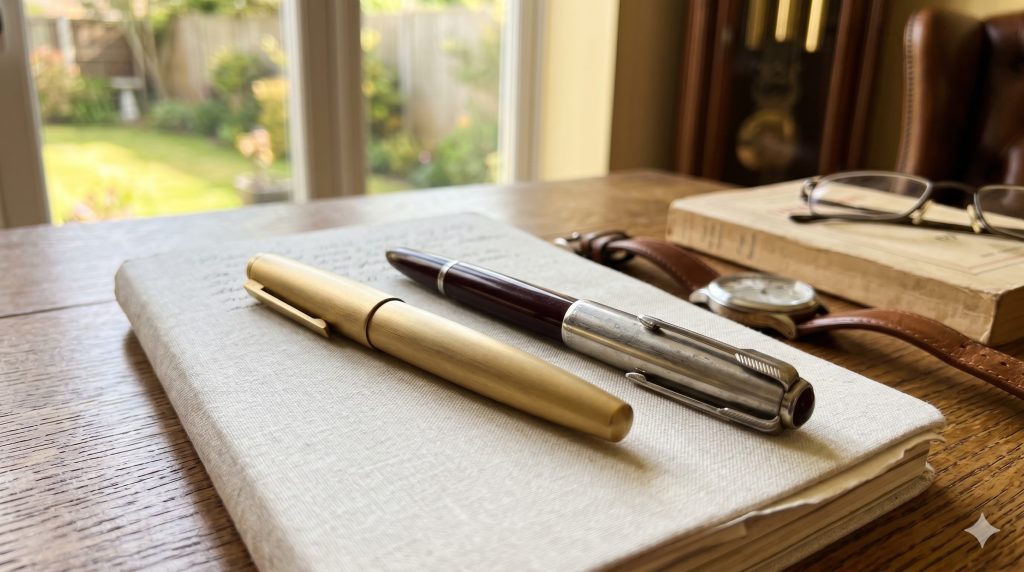
It was the best of pens, it was the worst of pens. Sorry — I couldn’t resist. There were, however, two pens, and between them they had something to say about parenting.
The first one was a beautiful Parker pen from Singapore. Its story started almost a hundred years ago. In the early twentieth century, waves of Chinese and Indian migrants arrived in Singapore. Some of the migrants of Indian origin came from my Malayalam-speaking native land of Kerala. Among them was Natarajan who would later come to be called the Singapore Appuppa (Grandpa). A cousin to my paternal grandfather, he was very fond of my father, who was among the first University graduates from that part of Kerala. He got him a Parker pen from Singapore as a graduation gift. Some fifteen years later, this pen would teach me a lesson I still have not fully assimilated, five decades on.
My father was very proud of his pen, its quality and sturdiness, and was bragging to his friends once. “I wouldn’t be able to break it, even if I wanted to!” he said, without noticing his son (yours faithfully), all of four years old then with only a limited understanding of hypothetical conditionals of this kind. Next evening, when he came back from work, I was waiting for him at the door, beaming with pride, holding his precious pen thoroughly crushed. “Dad, dad, I did it! I managed to break your pen for you!”
Heartbroken as my father must have been, he didn’t even raise his voice. He asked, “What did you do that for, son?” using the Malayalam term of endearment for “son.” I was only too eager to explain. “You said yesterday that you had been trying to break it, but couldn’t. I did it for you!” Rather short on language skills, I was already a bit too long on physics. I had placed the pen near the hinges of a door and used the lever action by closing it to accomplish my mission of crushing it. In fact, I remembered this incident when I was trying to explain to my then-wife (short on physics) why the door stopper placed close to the hinges was breaking the floor tiles rather than stopping the door.
My father tried to fix his Parker pen with scotch tape and rubber bands. Later, he managed to replace the body of the pen, although he could never quite fix the leaking ink. I still have the pen, and this enduring lesson in infinite patience.
The second pen was a gift from a favorite uncle of mine. He was a soldier in the Indian Army at that time. Soldiers used to come home for a couple of months every year or so, bearing gifts to everybody in the extended family. This pen that I got from my uncle was a handsome matte-gold specimen of a brand called Crest, possibly smuggled over the Chinese border at the foothills of the Himalayas and procured by my uncle. I was quite proud of this prized possession of mine, as I guess I have been of all my possessions in later years. But the pen didn’t last that long — it got stolen by an older boy with whom I had to share a desk during a test in the summer of 1977.
I was devastated by the loss. More than that, I was terrified of letting my mother know for I knew that she wasn’t going to take kindly to it. I guess I should have been more careful and kept the pen on my person at all times. Sure enough, my mom was livid with anger at the loss of this gift from her brother. A proponent of tough love, she told me to go find the pen, and not to return home without it. Now, that was a dangerous move. What my mom didn’t appreciate was that I took most directives literally. I still do. It was already late in the evening when I set out on my hopeless errand, and it was unlikely that I would have returned at all because I wasn’t supposed to — not without the pen.
My dad got home a couple of hours later, and was horrified at the turn of events. He certainly didn’t believe in tough love, far from it. Or perhaps he had a sense of my literal disposition, having been a victim of it years earlier. In any case, he came looking for me and found me wandering aimlessly around my locked-up school some ten kilometers from home.
Parenting is a balancing act. We have to exercise tough love to prepare our children for the harsh world later in life. We have to show love and affection as well, so that they may feel emotionally secure. We have to provide for them without being overindulgent, or we risk spoiling them. We have to give them freedom and space to grow, without becoming detached and uncaring. Tuning our behavior to the right pitch on so many dimensions is what makes parenting a difficult art to master. What makes it truly terrifying is that we get only one shot at it. If we get it wrong, the ripples of our errors may last a lot longer than we can imagine. Once, when I got upset with my son (then six, and already far wiser than his years), he told me that I had to be careful, for he would one day treat his children the way I treated him. But then, we already know this, don’t we?
My mother did prepare me for an unforgiving real world, and my father nurtured enough kindness in me. The combination is perhaps not too bad. But we all would like to do better than our parents. In my case, I use a simple trick to modulate my behavior toward my children. I try to picture myself at the receiving end of the said treatment. If I should feel uncared-for or unfairly treated, the behavior needs fine-tuning.
This trick does not work all the time because it usually comes after the fact. We first act in response to a situation, before we have time to do a rational cost-benefit analysis. There must be another way of doing it right. Maybe it is just a question of developing a lot of patience and kindness. You know, there are times when I wish I could ask my father.
My father passed away almost two decades ago. Somewhere in the days and years of soul-searching that followed, a close friend asked me, “Well, now that you know what it takes, how well do you think you are doing?” I didn’t think I was doing that well at that point, for some lessons, while easy enough to learn, were just too hard to put into practice. But this lesson in limitless patience does guide and inform the way I have treated my 3000 or so foster children, my students, over the last decade. In their teaching feedback, my students regularly compliment me on my patience. Unbeknownst to them, they are paying tribute to the lesson imparted by a broken Parker pen and its owner. He would have been proud.