
We are nearing the end of another term of teaching. It is the end of another tough course in Linear Algebra for my students. Today, as they are working through their second in-class assignment, I wanted to write down some of my thoughts, which I had originally planned to share in class.
Linear Algebra is not an easy course for my young undergraduate students of computer science. It stretches their imagination, challenges their intellect, and forces them to view and appreciate the same mathematical concepts from multiple perspectives. Moreover, unless taught with deliberate enthusiasm and careful attention to detail and applicability, it fails to inspire in them the respect this particularly elegant branch of mathematics rightly deserves. It is in this context that I wanted to take a step back and drive home the beauty of math using these ideas.
Let’s start with this scenario: In the morning, when we wake up and open our eyes, we see the world — the “reality” around us. There is beauty and symmetry all around us. Maybe we take a look at the sunlight peering through the curtains. Or the beautiful people on Instagram or TikTok. Or we are excited about the beautiful possibilities and projects of the day. These beauties are all real and exist in everything we have around us. But there is a deeper beauty waiting to be discovered. To catch it, we have to realize that by the process of seeing what’s around us, reality has become knowledge.
The surface beauty of this knowledge — what Pirsig called the romantic beauty — is not the only beauty out there for us. We have the structures and patterns that govern the underlying forms of our knowledge. They have a beauty of their own — an intense and burning one. This so-called classical beauty, the beauty of the underlying forms, is the one that mathematics exposes to us. In fact, the immense volumes of beauty in our reality are all written in the language of mathematics.
I know you might be skeptical of this last statement, written as it is by a math teacher. But it is true — and almost too obvious to see. Let me show it to you with one example. In the last couple of years, we have all been playing with the likes of ChatGPT, the large language models. Even this little piece will be proofread and corrected by an LLM before you get to read it.
LLMs know everything. They certainly know more Linear Algebra than I do. They write better than most people I know. They are even creative and wise. But what is this “model” in these LLMs? It is only a matrix (a large one) of numbers, and a few other matrices specifying the mathematical operations to perform on them. It is all just numbers. Yet the model itself “knows” everything. Doesn’t it stand to reason, then, to simply state that “knowledge” is just mathematics?
The conventional wisdom is that knowledge is something independent that is merely represented and harnessed in the model. Is it, though? We started this discourse by saying that when we open our eyes and consume reality, we create knowledge, which is only a model in our favorite computer — our brain — encoded in neuronal patterns. Why is that representation “reality,” while the one in an LLM is merely a “representation”? I know, I know — it’s because the knowledge that our brain created ended up in our languages, which the LLMs trained on and distilled the essence of. But, my friend, it’s all just models — our knowledge, the reality upon which it is built, the languages that we use to speak of it, and the LLMs that reverse-engineer it. As that famous (but nameless) old lady said, it’s turtles all the way down!
Not convinced yet? Consider this: In physics, perhaps the most comprehensive model of all, mathematics is not merely the language — it is almost the entire framework. From the quantized energy levels of subatomic particles (which are the eigenvalues of the so-called Hamiltonian operator), all the way to the evolution of the cosmos itself (described by a mathematical object, a higher-order generalization of matrices, called the energy–momentum tensor), everything is mathematics — with Linear Algebra serving, if not quite as the backbone, then certainly as a crucial part of the structure.
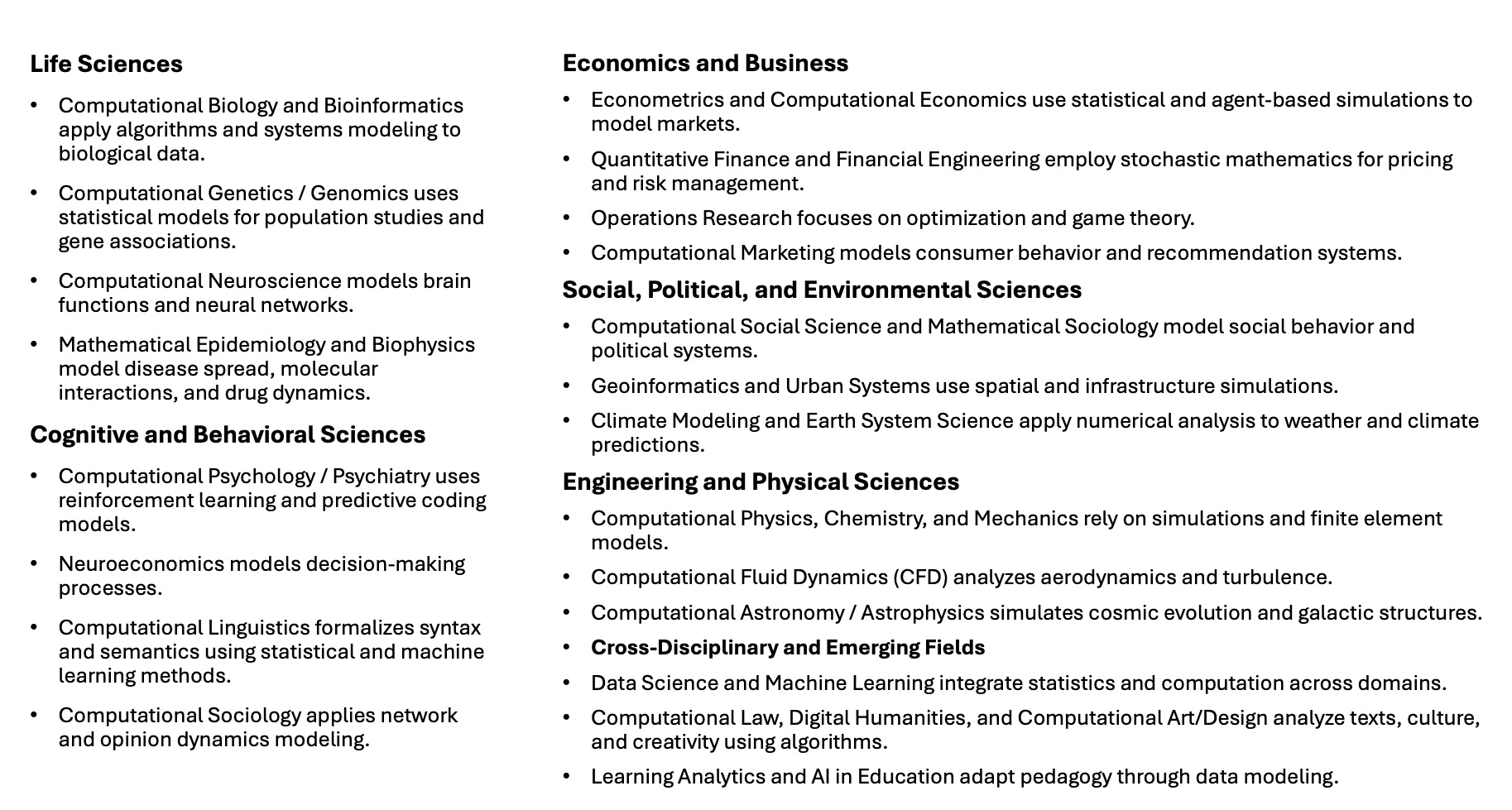
Also consider how most physical and social sciences are moving toward computational (and, by extension, mathematical) methodologies. Here’s an infographic kindly provided by — what else — ChatGPT:
Let me take another step back at this point and state this. As you may know, I am an atheist. But if I were to say that there was a god, I would say that it is the pure embodiment of mathematics. When you learn mathematics, you are acquiring the tools that let you glimpse at God’s own thoughts. What could possibly be more beautiful than that?
I am beginning to realize that perhaps I was right not to have shared these thoughts with my students. Maybe what is wise and appropriate for an aging professor is unnecessary — and even unholy — for young minds to be exposed to. Especially because this is only the tip of the iceberg.